Query Fan-Out Explained: What Gemini 4 Hydrogen Means for Singapore Business Pages
Google's Gemini 4 Hydrogen widened query fan-out in AI Mode and AI Overviews. What fan-out is, what Google and OpenAI have confirmed, and what Singapore businesses should change on their pages.


Query fan-out is the step where Google's AI Mode and AI Overviews split your question into smaller related searches, run them at the same time and build one answer from the results. Since 12 November 2026, Gemini 4 Hydrogen has been running that step more widely. For your site, each sub-question is now a separate chance to be cited.
Google announced the change on Thursday 12 November in California, which was the early hours of Friday 13 November in Singapore. Search Console won't flag it for you. Between 21 October and 19 November 2026, it recorded no query containing "fan-out" or "Hydrogen" for plexial.io. People are not searching for the term. They are just asking longer questions, and Google is breaking them apart.
This guide sets out what Google and OpenAI have actually said about fan-out, what they have not said, and what a Singapore business should change on its pages. Every official source linked below was opened on 20 November 2026.

What is query fan-out?
Query fan-out is a technique in which an AI search system turns one question into several related searches, runs them together and combines what it finds. Google's guide to optimising for generative AI features defines it as "a set of concurrent, related queries generated by the model to request more information and fetch additional relevant search results".
Google's own example is a lawn. Someone asks "how to fix a lawn that's full of weeds", and the fan-out might include "best herbicides for lawns", "remove weeds without chemicals" and "how to prevent weeds in lawn". Three searches the person never typed, each with its own set of results.
The AI Mode help page puts it more plainly: AI Mode divides "your question into subtopics and searching for each one simultaneously across multiple data sources". Google's page on AI features and your website adds the part that matters to site owners. Because the model finds more supporting pages while it writes, AI Overviews and AI Mode can show "a wider and more diverse set of helpful links" than a classic results page.
So fan-out is not new. Google has documented it since at least December 2025. What changed this month is how far it goes.
What did Gemini 4 Hydrogen change in Google Search?
Gemini 4 Hydrogen made Google's query fan-out wider. In its announcement, Robby Stein, Google's VP of Product for Search, said Hydrogen "supercharges our query fan-out technique", running "simultaneous queries across all the relevant subtopics" and "connecting you to a broader range of helpful links than before".
Here is what Google has confirmed, and where it stopped:
Claim | Source | Status |
|---|---|---|
Hydrogen is available in Google Search for all users, globally, from 12 November 2026 | Google Search blog | Confirmed |
It is the default model in AI Mode and is used for the hardest questions in AI Overviews | Robby Stein's thread on X, 12 November | Confirmed by a Google executive, not in the blog post |
Fan-out covers more subtopics and links to a broader range of sites | Google Search blog | Google's claim; no figures published |
Answers include more images, comparison tables and custom tools | Google Search blog | Confirmed as a feature; no figures published |
Better answers in every AI Mode language | Google Search blog | Confirmed; languages not listed in the post |
How many sub-queries a question now produces | Not published | Unknown |
How much extra traffic sites will see | Not published | Unknown |
The last two rows are the ones to remember when someone sells you a "fan-out optimisation" package with numbers in it. Google has not said how many searches Hydrogen runs per question, before or after the upgrade. Any count you see is a third-party estimate.
There is also a timing problem. Google's November 2026 core update began rolling out on 10 November (2am on 11 November, Singapore time) and can take up to two weeks. As of 20 November, the Search Status Dashboard showed no completion notice. Any ranking or AI visibility change you saw in mid-November could come from either.
Does ChatGPT use query fan-out too?
Yes, in practice, though OpenAI does not use the term. Its help page on searching the web with ChatGPT says ChatGPT search "typically rewrites your query into one or more targeted queries" sent to its search partners, and after reviewing the first results "may send additional, more specific queries".
Three details on that page matter for Singapore businesses:
- ChatGPT uses your approximate location from your IP address, and can rewrite "good restaurants near me" into a search for a named city. A Singapore user's question is likely to pick up a Singapore qualifier they never typed.
- If memory is switched on, ChatGPT may use saved memories when it rewrites the search. Two people asking the same question can trigger different searches.
- ChatGPT ranks results "using multiple factors" and "placement is not guaranteed". To be eligible at all, a site has to let OpenAI's crawler, OAI-SearchBot, in.
You may have read that ChatGPT's fan-out also got wider this autumn, or that it now searches inside specific brand websites. Several SEO tool vendors have published studies along those lines. OpenAI has not announced any such change, so treat those findings as observations from outside, not as policy. For a full walk-through of how ChatGPT chooses businesses, see our guide to getting your business recommended by ChatGPT.
How does AI search pick sources once it has fanned out?
Google picks sources for each sub-query with the same ranking and quality systems it uses for ordinary search, then reads the retrieved pages to write and support the answer. Google calls that second step retrieval-augmented generation, or grounding. Fan-out decides which questions get asked; ranking decides which pages answer them.
That has two consequences.
First, the entry ticket has not changed. A page must be indexed and eligible to show with a snippet, and the site must be included in Search Console's generative AI control. Google says there are "no additional technical requirements". Our guide on how to appear in Google AI Overviews and AI Mode covers those checks one by one.
Second, a page can now be cited for a question it never ranked for. If a customer asks AI Mode about a whole renovation project, the permit timeline might be one sub-query, the cost per square metre another and the defects warranty a third. The contractor with the clearest permit page can be cited even if a bigger rival owns the main search term.
ChatGPT's process looks similar from the outside: rewrite, search, read, cite. OpenAI does not publish a ranking method beyond "multiple factors". Its help page points to Microsoft's privacy statement for the search providers it uses, so checking how your pages appear in Bing costs little.
What does wider fan-out mean for a Singapore business page?
Wider fan-out rewards pages that answer one specific part of a buyer's question completely, and it shrinks the advantage of a broad page that answers everything vaguely. If Google now runs more sub-queries per question, each one is a separate contest, and the strongest general page will not win all of them.
Our own Search Console data shows what these questions look like. Between 21 October and 19 November 2026, 123 of the 596 distinct queries Google reported for plexial.io were eight words or longer. Together they earned 565 of the 14,191 impressions in that query-level data, and no clicks. One of them reads: "seo or geo: which does my business need to show up on google and in chatgpt, and which agencies in singapore do both?"
That is three questions in one. A fan-out system could reasonably split it into "SEO vs GEO", "how to show up in ChatGPT" and "agencies in Singapore offering SEO and GEO". Google showed two different Plexial articles for it, ranking around sixth, and neither answered all three parts. Search Console does not show the sub-queries, so this split is our reading, not Google data. But the lesson holds: a page that answers each part clearly, under its own heading, gives the system something to cite for each sub-query.
There is a Singapore-specific angle too. Google's AI Mode help page lists Singapore among supported countries, with English, Chinese, Malay and Tamil all on its language list, and Hydrogen is meant to improve answers in every AI Mode language. Google has not said how fan-out handles each language, but a customer who asks in Chinese is unlikely to be well served by a site whose only Chinese content is a translated homepage banner.
How should you plan content around fan-out without breaking Google's rules?
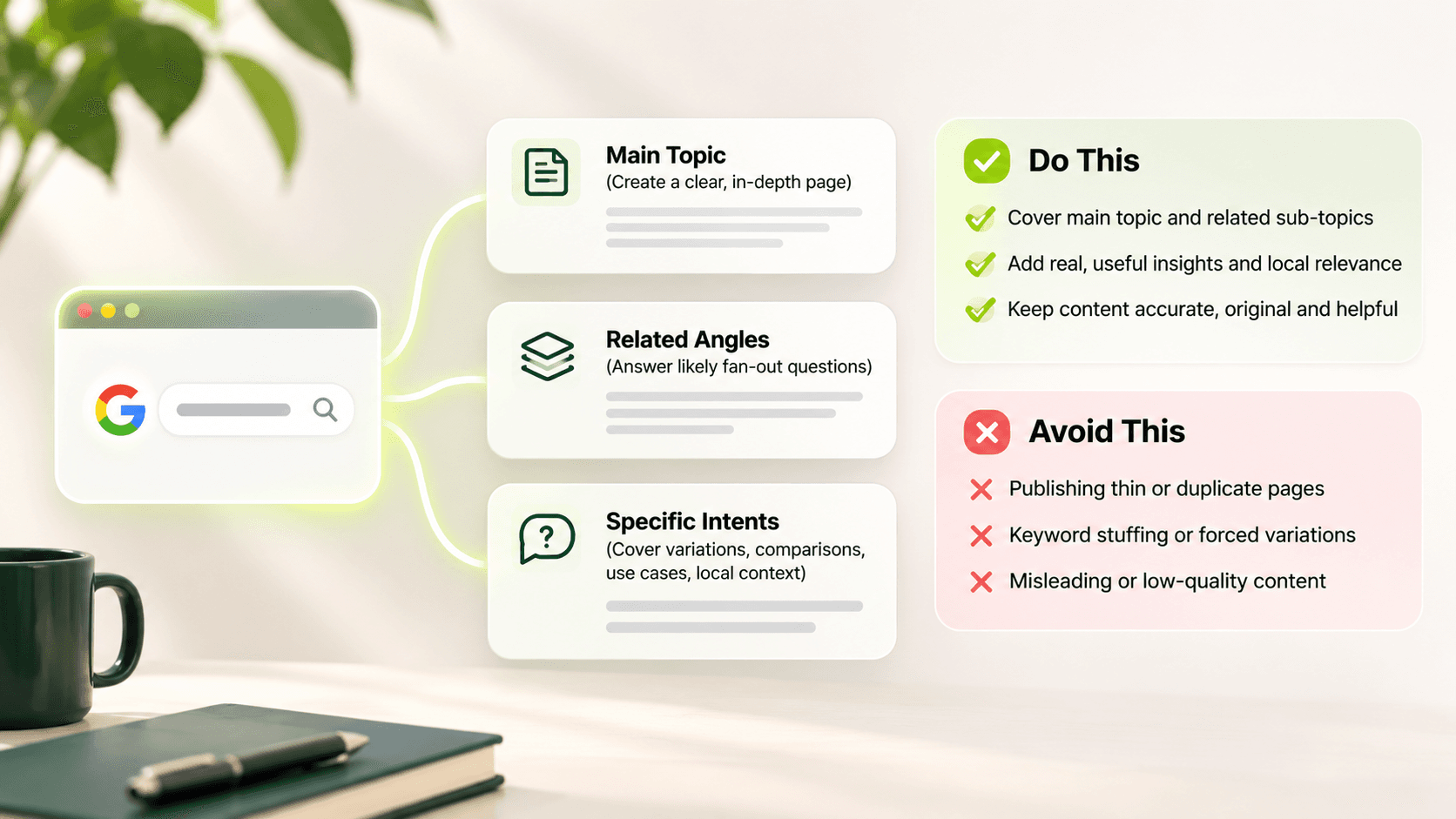
Plan around the questions your buyers actually ask, then make sure each part of those questions has a clear answer somewhere on your site. Do not create a page for every sub-query you can imagine. Google's generative AI guide says that producing separate content for "fan-out queries" primarily to manipulate rankings or AI responses violates its scaled content abuse policy.
The same guide says you do not need to chop content into tiny chunks, and that its systems understand synonyms, so chasing every long-tail variation is wasted effort. The work is closer to editing than to mass publishing.
A practical way to start is a three-column map. Here is how it might look for three common Singapore businesses:
Buyer question | Sub-questions a fan-out might run | Where your site should answer |
|---|---|---|
Which physiotherapy clinic in Tampines can see me this week for a slipped disc? | Clinics near Tampines; slipped disc physiotherapy; same-week appointments; insurance claims | Clinic location page with hours and booking lead time; condition page; a payment and claims section |
How much does it cost to renovate a 4-room HDB resale flat, and how long does it take? | 4-room HDB renovation cost; HDB renovation permits; renovation timeline; contractor licensing | Pricing guide with dated ranges; a permits and timeline page; credentials on the About page |
Which accounting firm can handle GST registration for a new Pte Ltd? | GST registration threshold; GST registration process; accounting firms for startups; fees | GST service page that states the steps, timeline and fee basis; a startup package page |
The right-hand column matters most. Most sites already have the service page. What they lack is the specific fact a sub-query is looking for: the actual lead time, the dated price range, the step order. Those are facts only you can supply, which is also what Google's guide means by "non-commodity content".
Three editing habits help:
- Answer each question in the first sentence under its heading, then explain.
- Put concrete facts in text, not only in images or PDFs: prices with a date, service areas, turnaround times, eligibility rules.
- Keep one strong page per real intent. Ten near-identical suburb pages are what the scaled content policy describes.
Our pillar guide on AI search optimisation for Singapore businesses covers the wider SEO, GEO and AEO picture this fits into.
How can you tell whether fan-out is sending you traffic?
You can measure the results of fan-out but not the fan-out itself. Search Console's Generative AI performance report, live for all sites since 31 August 2026, shows how often links to your site appeared in AI Overviews and AI Mode, by page, country, device and date. It does not show the sub-queries Google ran.
Google's Search Console documentation on clicks and impressions adds two rules worth knowing. A click on an external link in AI Mode counts as a click. And a follow-up question in AI Mode counts as a new query, with its own impressions and clicks.
For a clean read on Hydrogen:
- Wait until the November core update is marked complete on the Search Status Dashboard.
- In the Generative AI report, filter by country (Singapore) and compare the four weeks after the update with the four weeks before 10 November.
- Sort by page. Look for pages that gained AI impressions without gaining classic rankings. Those are likely being pulled in through sub-queries.
- Check those pages in your analytics for enquiries, not only visits.
For ChatGPT, watch referrals from chatgpt.com in your analytics and run a fixed list of buyer prompts each month, noting which pages get cited. Answers change from one run to the next, so record dates. Our article on tracking Google AI Overviews visibility sets out the full method, and our comparison of AI Overview tracking tools covers the paid options.
What should you do in the next 30 days?

Start with the pages that already bring in enquiries, not with new content. A short list:
- Write down the ten longest real questions customers ask by email, WhatsApp or phone.
- Split each into its parts, as in the table above.
- Check whether each part has a direct, factual answer on your site. Fix the gaps on existing pages first.
- Confirm the basics: pages indexed, snippets allowed, the site included in Search Console's generative AI control, and OAI-SearchBot allowed in robots.txt.
- Update your Google Business Profile. Google's generative AI guide says Business Profile details can help local businesses appear in AI responses. Our guide to ranking higher on Google Maps in Singapore covers the profile.
- Take a dated baseline in the Generative AI report and in ChatGPT, then check again once the core update finishes.
If an agency pitches you a fan-out package, our guide on how to choose a GEO or AEO agency in Singapore lists the questions to ask.
Frequently asked questions
What is query fan-out in Google AI Mode?
It is how AI Mode answers a question: it splits the question into subtopics, searches for each one at the same time and combines the results into one response with links.
Did Gemini 4 Hydrogen change query fan-out?
Yes. Google says Hydrogen, in Search from 12 November 2026, runs fan-out across more subtopics and links to a broader range of sites. Google has not published how many sub-queries it runs.
Does ChatGPT use query fan-out?
ChatGPT rewrites questions into one or more targeted searches and may send follow-up searches after reading the first results. OpenAI has not announced any widening of this in November 2026.
Should I create a page for every fan-out query?
No. Google says creating separate content for fan-out queries mainly to manipulate AI answers breaks its scaled content abuse policy. Answer each real buyer question well on the pages you have.
Can I see Google's fan-out queries in Search Console?
No. The Generative AI performance report shows impressions in AI Overviews and AI Mode by page, country, device and date, but not the sub-queries Google ran.
Fan-out favours the specific page
Google has said plainly that Hydrogen links to more sites than before, and it has said nothing about how many. That leaves Singapore businesses with an editing job, not a technical one: answer each part of a buyer's question with facts only you can give, on pages Google and ChatGPT can read.
Plexial runs GEO and AEO and SEO programmes for Singapore businesses, covering Google's AI features and ChatGPT. If you want your most important buyer questions mapped against your site, get in touch.
Written by
Jae Tan
Jae shares insights on technology, digital innovation, and business trends, helping businesses navigate change and uncover new opportunities.