How to Choose a GEO or AEO Agency in Singapore: Questions to Ask and Red Flags
Google's own hiring advice covers AEO and GEO services. Here is how to vet a Singapore agency: the questions to ask, the red flags, and what a fair proposal includes.


Choose a GEO or AEO agency the way Google tells you to choose an SEO. Ask for evidence of past work, check that its advice matches Google's published guidance, walk away from guarantees, and keep ownership of your accounts. A good Singapore agency shows you what AI tools say about you today before it quotes.
That last test takes about ten minutes to check, and it tells you a lot. "GEO" and "AEO" became sales terms faster than they became disciplines, and in 2026 almost every digital agency in Singapore sells some version of them. Some of that work is solid SEO with a new label. Some of it breaks Google's spam policies.
A disclosure before we start: Plexial sells GEO and AEO services. Everything below applies to us too, and the sources are Google's and OpenAI's own documentation rather than our opinion.
What does a GEO or AEO agency actually do?
A GEO or AEO agency works to get your business mentioned, cited and recommended in AI-generated answers, such as Google's AI Overviews and AI Mode, ChatGPT, Gemini and Perplexity. GEO (generative engine optimisation) focuses on being named in those answers; AEO (answer engine optimisation) focuses on being the source of a direct answer. Our guide to SEO, GEO and AEO covers the definitions in full.
Google's position is blunt. Its guide to optimising for generative AI features, last updated in July 2026, says that from Google Search's perspective, optimising for generative AI search "is optimizing for the search experience, and thus still SEO". AI Overviews and AI Mode pull pages from the same index and ranking systems as ordinary results.
So the real work looks familiar. Expect an agency to:
- Run a baseline: a fixed list of the questions your buyers ask, put to each AI platform, with the answers and cited sources recorded.
- Fix what stops AI systems reading your site, from indexing problems to a robots.txt file that blocks OAI-SearchBot, the crawler OpenAI uses to surface websites in ChatGPT search.
- Rewrite or build pages that answer specific buyer questions directly, with facts only you can supply.
- Work on what others say about you: directories, reviews, press, and the "best of" lists AI tools quote.
- Track mentions, citations and, most importantly, enquiries.
Do you need a separate GEO agency, or will your SEO agency do?
Most Singapore businesses do not need two agencies. Because AI Overviews and AI Mode run on Google's core ranking systems, an SEO team that already handles your technical health and content is doing much of the groundwork for AI search.
A specialist earns its fee in three situations: when your SEO agency cannot show you how you appear in ChatGPT or Perplexity answers, when competitors are being named in AI answers for your category and you are not, or when your buyers research mainly through AI assistants. What matters is that whoever does the work treats SEO and GEO as one plan, so two teams aren't pulling your pages in different directions.
What questions should you ask a GEO or AEO agency before signing?
Start with the questions Google itself recommends in its page Do you need an SEO?, updated in June 2026. Among its questions is whether an agency's AEO or GEO advice "is aligned with Google Search's official guidance on optimizing for generative AI features". The table adds the questions specific to AI search.
Question | A good answer | A weak answer |
|---|---|---|
What do AI tools say about us today? | A dated list of buyer questions, run on named platforms, with the answers and sources shown | A single "AI visibility score" with no method behind it |
Which questions will you track, and who chose them? | A prompt list agreed with you, based on how your customers actually ask | Generic prompts, or a list you never see |
What will you change on our site, and why? | Specific pages and fixes, each tied to Google or platform documentation | "Our proprietary framework" |
What will you do off our site? | Named directories, publications or lists, with how they plan to earn the mention | "Citation seeding" across hundreds of sites |
Can you show past work and give references? | Named or verifiable examples, plus a client you can call | Screenshots of AI answers with no date or context |
How will you report, and how often? | Citations and mentions alongside traffic and enquiries, on a set schedule | Rankings and impressions only |
What access do you need? | Restricted access to Search Console for the audit | Owner access to everything on day one |
What happens if we leave? | You keep the content, accounts, prompt list and data | Content or accounts held by the agency |
Pay attention to what the agency asks you. Google's advice is that a good SEO should want to know what makes your business different, who your competitors are and how your customers find you. The same holds for GEO. An agency that quotes before asking those questions is selling a package, not a plan.
What are the red flags when hiring a GEO agency?
The biggest red flag is a guarantee. No agency controls what ChatGPT, Gemini or Google's AI features say, and Google states that "no one can guarantee a #1 ranking on Google". A promised ChatGPT recommendation is the same claim with a different logo.
Watch for these as well:
- A "special relationship" with Google or OpenAI, or a "priority submit". Google names both as warning signs.
- An llms.txt file sold as a way to rank in Google. Google says Search ignores llms.txt and that you can skip "chunking" content into small pieces. We publish an llms.txt on plexial.io for other AI services, but it does nothing for Google, and an agency that says otherwise hasn't read the documentation.
- Bought or faked "mentions". Google's guide says seeking inauthentic mentions "isn't as helpful as it might seem", and its spam policies define spam to include attempts to manipulate generative AI responses in Search. Fake reviews, planted forum posts and paid links dressed up as citations all carry that risk.
- Hundreds of AI-written pages, one per question or suburb. Google classes pages generated at scale without adding value for users as scaled content abuse.
- Owner-level access for an audit. Google advises granting only read access to Search Console at that stage; Search Console's permission levels let you add someone as a Restricted user, who can view most data but change nothing.
- Tools that claim to use Google's data. Google says no third-party tool has access to its internal ranking or AI systems. Tracking tools are useful, as our comparison of AI Overview trackers shows, but they sample answers rather than read Google's mind.
- An agency's own "best GEO agencies in Singapore" list, with itself at number one, offered as the main proof.
How should a GEO agency measure results?
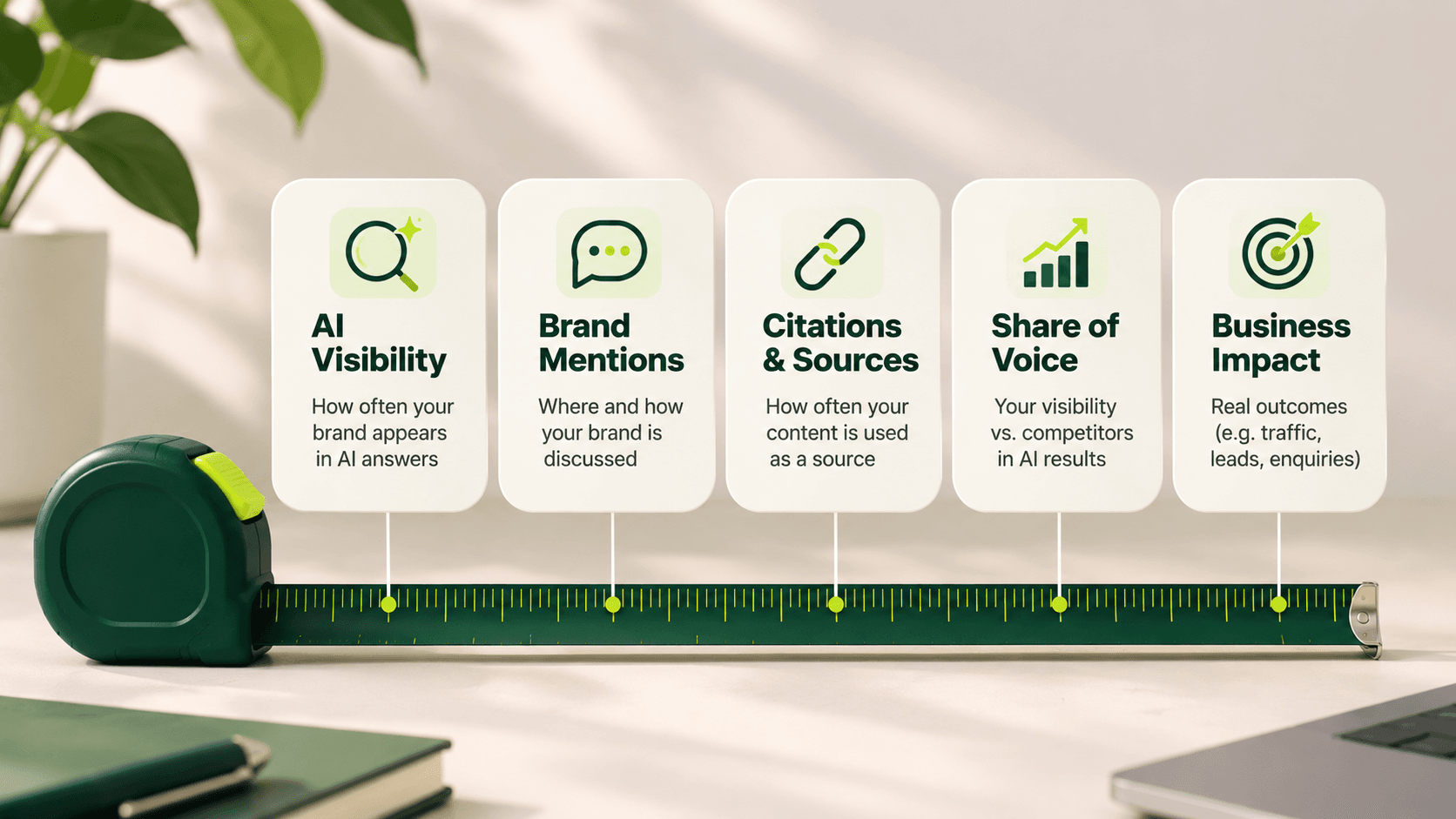
A GEO agency should measure against a dated baseline of buyer questions, and report on enquiries as well as mentions. Without the baseline, any later improvement is a story, not a measurement.
Good reporting usually combines three sources:
- The prompt set. The same questions, run on the same platforms at regular intervals, showing whether you are mentioned, cited as a source, or absent, and who appears instead. AI answers change from one run to the next, so a single screenshot proves little.
- Google's own data. Since 31 August 2026, Search Console's Generative AI performance report has been available to all sites worldwide. It shows impressions in AI Overviews and AI Mode by page, country and device, once a site has enough of them. Our guide to tracking Google AI Overviews visibility shows how to read it.
- Business results. Traffic from AI platforms, form fills, calls and WhatsApp enquiries. Citations matter because they lead to these.
Ask how long the agency expects each to take to move, and get it in writing. Our article on how long it takes to appear in AI search results explains why the timeline varies so much between businesses.
How much should GEO and AEO cost in Singapore?
Few Singapore agencies publish GEO prices, so most quotes are hard to compare. Of three large Singapore agencies we checked on 18 November 2026, one lists a one-off AI visibility audit at S$2,500 and GEO and AEO retainers from S$3,800 a month; the other two quote on request.
All three advertise a free audit or strategy session "valued at" or "worth" between S$1,888 and S$4,200. We offer a free AI visibility audit too. Treat any free audit as a sales conversation and judge it on whether it shows you real AI answers for your own buyer questions.
Price matters less than what the fee buys. A retainer that is mostly reporting costs you more than a pricier one that ships page fixes every month. For ordinary SEO price ranges, see our breakdown of SEO costs in Singapore. If you were hoping a government grant would cover the bill, our article on grants for SEO and GEO explains what changed when PSG and EDG closed to new applications on 29 September 2026.
What should a fair GEO proposal include?
A fair GEO proposal states what the agency will do, how often, who will do it, and how you leave. If any of the items below is missing, ask for it in writing before you sign.
Item | What to look for |
|---|---|
Baseline | Current AI answers for your agreed questions, dated, with sources |
Platforms | Which ones are tracked: Google AI Overviews, AI Mode, ChatGPT, Gemini, Perplexity |
On-site scope | Number of pages fixed or written each month, plus technical work |
Off-site scope | Where mentions will come from and how they will be earned |
People | Who does the work, and who is your point of contact |
Reporting | What is reported, how often, and in what format |
Access | Restricted or Full user access unless there is a stated reason for more |
Ownership | You own the content, accounts, data and prompt list |
Term and exit | Minimum term, notice period, and what you receive when you leave |
Exclusions | What is not included, such as ad spend or content production |
Why do "best GEO agency in Singapore" lists disagree?
They disagree because many are written by agencies ranking themselves. That would be a curiosity, except AI tools quote these lists heavily.
When Noder put 100 buyer questions to ChatGPT and Perplexity on 10 November 2026, 44% of the 1,503 citations in their answers went to best-of lists, and 84% of answers with sources cited at least one list, according to its published study. One in ten of those list citations pointed to a list a firm had published about its own trade.
So when you ask an AI assistant for "the best GEO agency in Singapore", part of what comes back may be agency marketing. Read any list with three questions: does it explain how it ranked, is it dated, and does the publisher say whether it sells the service? A list that answers all three is worth more than one that doesn't, whoever tops it.
How do you shortlist a GEO agency in two weeks?
You can shortlist in two weeks by doing a small version of the baseline yourself first, then making every agency respond to the same brief.
- Write 15 to 20 questions your buyers would ask an AI assistant, in their words: "Which accounting firm in Singapore handles GST for small online shops?", not "accounting services".
- Ask each question in ChatGPT, Gemini, Perplexity and Google's AI Mode. Screenshot the answers and note the date, who is named and which sites are cited.
- Send the same questions and screenshots to three agencies and ask each what it would change first.
- Add the agencies you're serious about as Restricted users in Search Console, so their audits use your real data without any ability to change settings.
- Compare the proposals against the table above, then call one reference for each.
- Start with a fixed-scope audit or a short pilot with clear deliverables before committing to a long retainer.
The answers to step 3 tell you most of what you need. A strong agency will point at specific pages, specific missing sources and specific competitors. A weak one will send a deck.
Frequently asked questions
Can any agency guarantee that ChatGPT will recommend my business?
No. AI platforms decide what they show, and their answers change from run to run. An agency can improve the signals that make a mention more likely, but a guarantee is a red flag.
Is GEO different from SEO?
For Google, no: Google says optimising for its AI features is still SEO. For ChatGPT, Perplexity and Gemini, GEO adds work such as checking AI crawler access and earning mentions on the sources those tools cite.
What Search Console access should I give a GEO agency?
Give Restricted user access for an audit. That lets the agency view most reports without changing anything. Upgrade to Full user only if the work requires it, and keep ownership yourself.
Do I need an llms.txt file to appear in AI answers?
Not for Google, which says Search ignores llms.txt. Some other AI services may read it, so it is optional and cheap, but it is not a reason to hire an agency.
How do I check an agency's own AI visibility?
Ask ChatGPT, Perplexity and Google's AI Mode the questions its prospects would ask, such as "best GEO agency in Singapore", and see whether it is named and which sources are cited. Then ask the agency to explain the result.
Talk to Plexial about GEO and AEO
Plexial is a Singapore agency that runs SEO, GEO and AEO as one plan. We start with a free AI visibility audit built on your own buyer questions, we don't guarantee placements, and we report AI mentions and citations alongside traffic and enquiries. See how our GEO and AEO service works, or book a consultation and put the questions in this guide to us.
Written by
Jae Tan
Jae shares insights on technology, digital innovation, and business trends, helping businesses navigate change and uncover new opportunities.