How to Choose a Google Ads Agency in Singapore: Partner Badge, Account Ownership and Fees
What to check before hiring a Google Ads agency in Singapore: Google Partner status, who owns the ad account, what reports must show, contract terms and the red flags Google warns about.


To choose a Google Ads agency in Singapore, check four things before price: that the Google Ads account sits in your company's name with you as admin, that any Google Partner badge links to a live Google profile, that reports show Google's exact charges separately from the agency's fee, and that you can leave without losing your account history.
Most of those checks take minutes. Few business owners run them, because the sales conversation is usually about keywords, creatives and a monthly fee. The trouble tends to show up a year later, when you try to switch agencies and find that the account, the conversion tracking and two years of bidding data belong to someone else.
This guide is built on Google's own rules for agencies, which Google calls third-party partners, and on its help pages for the Partners programme and account access. Every Google page linked below was opened on 25 November 2026. A disclosure: Plexial is a Google Ads agency in Singapore, so everything here applies to us too.
Does a Google Partner badge mean an agency is good?
A Google Partner badge means an agency has passed three thresholds Google checks every day: performance, spend and certification. It shows the agency is active and trained. It does not measure whether its clients made money.
Google's page on how to become a Google Partner or Premier Partner sets the bar:
Requirement | What Google asks for |
|---|---|
Performance | An optimisation score of at least 70% on the agency's registered manager account |
Spend | US$10,000 in ad spend across managed accounts over 90 days |
Certification | At least 50% of the agency's account strategists certified in Google Ads, with one certification in each product area that spends US$500 or more in 90 days |
Two details matter for a buyer. First, the optimisation score is Google's estimate of how well an account is set up to perform. Google's optimisation score help page says that applying or dismissing its recommendations changes the score, and the Partner rules let agencies dismiss recommendations they disagree with. A high score shows an account follows Google's checklist; it does not show sales. Second, the spend threshold is about the agency's total book, not about results for any client.
Premier Partner is a different tier. Google gives it to Partners in the top 3% of participating companies in each country, assessed once a year on client spend growth, new client growth, client retention, spend outside Search and annual spend. Those are sensible signals of a stable agency. Your return on ad spend is not one of them.
Treat the badge as a minimum filter. An agency without one may still be competent, particularly a small team below the spend line. An agency that displays a badge it does not hold is a firm no.
How do you check an agency's Google Partner status?
Click the badge on the agency's website. Google's advertiser guide to working with third parties says a genuine badge takes you to the company's profile page on Google. A badge that is just an image, or that links back to the agency's own site, proves nothing.
You can also search the Google Partners directory by company name and location.
Two things trip buyers up:
- Individual certificates are not company status. A salesperson can hold a Google Ads certification without the agency being a Partner. Google's page about Google Ads certifications says plainly that a company "doesn't become a Google Partner simply by joining the program".
- Status can lapse. Google's guide to checking Partner status says an agency that stops meeting the requirements has a 60-day grace period, after which it loses the right to use the badge. A badge on a 2023 brochure tells you little about 2026.
While you are checking, look up the company itself. Bizfile, ACRA's portal, confirms that the entity named on the proposal exists and is live. If the quote adds 9% GST to the management fee, the IRAS GST Registered Business Search shows whether the company is actually GST-registered.
Who should own the Google Ads account?
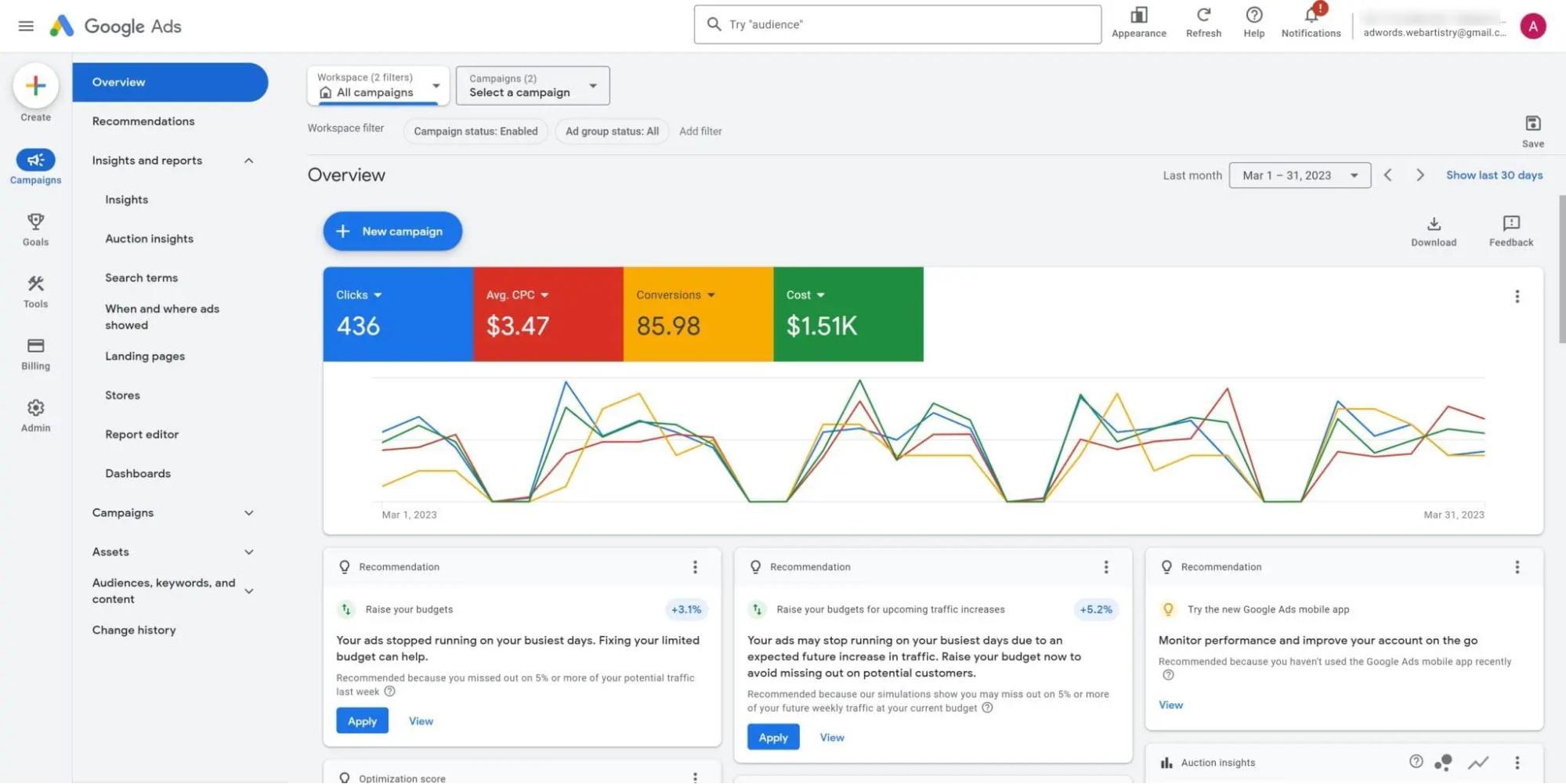
Your company should. The Google Ads account should be opened under a company email address you control, paid with your company's card or invoicing, and you should hold Admin access from day one. The agency then works through its own manager account, linked to yours.
This matters more than any line in the proposal. Your account holds the conversion history, audience lists and performance data that Smart Bidding learns from. Lose the account and you start that learning again.
Google's help page on manager account ownership explains the mechanics. A client account can have only one owner manager. If an agency's manager account creates a new account, it becomes the owner automatically. If the agency links to an account you already own, it does not get ownership unless you switch it on. Even then, Google says the client account "still owns its data" and an admin on your side can always unlink the manager.
Google's page about access levels shows what each level can do:
Access level | Can edit campaigns | Can add or remove users and unlink managers | Can edit billing |
|---|---|---|---|
Admin | Yes | Yes | Yes |
Standard | Yes | No | Yes |
Read-only | No | No | No |
Billing | No | No | Yes |
Keep Admin for at least two people in your company. Google warns that an account with a single administrator can lose access to its tags if that person becomes unavailable. Give the agency Standard access or a manager link, which is enough to run campaigns. Google's guide to managing access walks through inviting users and changing their level.
The same logic covers the tools around the account. Google Analytics, Google Tag Manager, Merchant Center for online stores and the conversion tags on your site should all be in your company's name, with the agency added as a user. If you run Shopping campaigns, our guide to Google Shopping and remarketing ads covers what Merchant Center needs.
What should a Google Ads agency report to you every month?
At minimum, the clicks, impressions and total cost of your Google ads, with the amount Google charged shown separately from the agency's fee. That comes from Google itself. Its advertiser guide says you have "the right to know the number of clicks, impressions, and the total cost" of your ads.
Google's transparency requirements for third parties go further:
- Where Google's terms require a monthly report, it must include costs, clicks and impressions at account level, showing "the exact amount charged by Google, exclusive of any fees".
- A management fee must be disclosed in writing before your first purchase and shown on every invoice.
- The agency must give you your Google Ads customer ID when you ask for it, so you can contact Google directly.
- An agency where 80% or more of clients spend under US$1,000 a month must share Google's advertiser guide with every client and link it from its website.
Clicks and impressions are the floor, not the goal. A useful monthly report also shows conversions you can tie to revenue: enquiries, bookings, sales and their value, the cost of each, and the search terms that produced them. If an agency cannot show conversions, ask whether conversion measurement is set up at all. Without it, Smart Bidding is guessing. Our article on why websites get traffic but not enquiries covers what to check when clicks rise and leads do not.
Admin access makes much of this self-checking. With your own login you can compare the agency's spend figure against the billing page in Google Ads in under a minute.
How do Google Ads agencies charge in Singapore, and what should the contract say?
Singapore agencies usually charge a percentage of ad spend, a flat monthly fee or a mix of both, on top of the ad spend you pay Google. Our guide to what Google Ads costs in Singapore compares the three models and how to set a first budget. Plexial's own management fee is 20% of monthly ad spend, billed separately from the budget you pay Google directly.
The fee model matters less than the terms around it. Before signing, get these in writing:
- Ad spend goes to Google from your payment method. If the agency pays Google and re-bills you, ask for Google's invoices.
- The fee is stated as a number, with GST shown separately if the agency is GST-registered.
- Set-up work is priced and its outputs are listed. Conversion tracking, landing pages and feed fixes should be named deliverables.
- The minimum term and notice period are stated. Long lock-ins with no performance review point are a warning sign.
- Everything built for you stays with you. That includes ads, assets, audience lists, landing pages and tracking.
- There is a handover clause. On exit, the agency removes its manager link, returns any admin rights and leaves campaigns running or paused as you choose.
Google's advertiser guide names "deceptive pricing" as something to watch for, where an agency does not spend the budget agreed with you, and tells advertisers to "get an official copy of your agreement in writing".
What questions should you ask a Google Ads agency before signing?
Ask about ownership, measurement and exit first, and creative ideas second. The answers to the first three are easy to verify and hard to fake.
Question | A good answer | A weak answer |
|---|---|---|
Whose name is the Google Ads account in? | Yours, with your team as Admin; we link through our manager account | We create it under our account to make things easier |
Are you a Google Partner, and can I see your profile? | Yes, here is the link to our Google profile, or no, and here is why | A badge image with no link |
What will you track as a conversion? | Named actions such as form submissions, calls or purchases, with values where possible | Clicks and click-through rate |
How will I see what Google charged? | You have Admin access, and our report splits Google's charges from our fee | A single blended monthly figure |
What happens in the first 90 days? | An audit, tracking set-up, then launch and weekly search-term reviews | Instant results from launch week |
What do you need from us? | Margins, sales cycle, lead quality feedback and who answers enquiries | Only a budget |
What happens if we leave? | You keep everything; we remove our access on your notice date | Fees or delays to release the account |
Who works on our account day to day? | A named person, with their certifications | "Our team" |
Watch what they ask you. An agency that never asks about your margins, average order value or how fast your team calls back leads is going to optimise for clicks, because clicks are all it understands about your business.
What are the red flags when hiring a Google Ads agency?

The clearest red flags are the ones Google lists itself. Its advertiser guide tells businesses to watch for agencies that:
- Guarantee a position, such as the top ad every time. Google says ad position "is determined by an auction and changes dynamically with every new search", so no one can promise it.
- Claim ads will improve your organic ranking. Google states that advertising "has no impact on your organic or natural ranking". SEO is separate work; our SEO service is priced and reported separately for that reason.
- Claim to be from Google. Google staff use @google.com email addresses; a Gmail address proves nothing.
- Pressure you into signing, including claims they can remove your business from Google's organic results. They cannot.
- Hide cost and performance data.
- Run several clients in one Google Ads account. Google's third-party policy requires a separate account for each advertiser.
Add a few of our own, drawn from the access and reporting rules above. Be wary of an agency that refuses you Admin access, reports only clicks and impressions after the first month, or won't say who will actually manage your account.
Should you hire an agency, a freelancer or run Google Ads yourself?
Run it yourself if you have the time to check search terms every week and your budget is small enough that a management fee would eat into it. Hire help when Google Ads is a meaningful share of your new business and nobody in-house owns it.
Option | Suits | Watch for |
|---|---|---|
Do it yourself | Owners with a few hours a week and a single, simple service | Broad keywords left unchecked; no conversion tracking |
Freelancer | Small accounts with one or two campaign types | Cover when they are away; who owns the tracking set-up |
Agency | Businesses running several campaign types (Search, Performance Max, Shopping, YouTube) or tying ads to SEO and AI search | Junior staff on your account; fees that rise with spend without more work |
Google's own advice, in the same advertiser guide, is to work with one partner at a time rather than splitting your budget between several to compare them. Google shows no more than one ad for a business on a page of search results, so two agencies running your ads at once make a fair comparison close to impossible.
If you are also choosing help for AI search, the questions differ. Our guide to choosing a GEO or AEO agency covers that side.
Frequently asked questions
Is a Google Premier Partner better than a Google Partner?
Not necessarily for you. Premier Partner goes to the top 3% of Partners in a country, ranked yearly on client spend growth, new clients, retention and spend outside Search. It signals a large, stable agency. It does not measure results for clients of your size.
Can a Google Ads agency guarantee the top position?
No. Google says ad position is set by an auction on every search. An agency that guarantees the top spot is misrepresenting how Google Ads works, according to Google's own advertiser guide.
Can the EDGE Grant pay for Google Ads management?
The EDGE Grant does not pay for ad spend. It can co-fund an IMDA pre-approved Digital Marketing Package for eligible SMEs. Our guide to government grants for SEO and GEO explains what it covers.
Do Google Ads help my SEO ranking?
No. Google states that advertising has no effect on organic rankings. Ad data can still show which searches turn into customers, which helps you decide what SEO content to write first.
What happens to my Google Ads account if I change agencies?
If the account is in your name, nothing is lost. You remove the agency's manager link or access, and the campaigns, history and audiences stay with you. If the agency created and owns the account, ask for ownership to be transferred before your notice period ends.
Talk to Plexial about Google Ads
Plexial runs Search, Performance Max, Shopping and YouTube campaigns for Singapore businesses. You pay your ad spend to Google directly, and our 20% management fee sits separately from it. Every engagement starts with an audit of your account, tracking and landing pages. See how we work on our Google Ads service page, or book a consultation.
Written by
Jae Tan
Jae shares insights on technology, digital innovation, and business trends, helping businesses navigate change and uncover new opportunities.