How to Advertise on ChatGPT in Singapore: Setup, Costs and What to Check First
Advertise on ChatGPT in Singapore: setup, minimum SGD 25 daily budget, what you can't advertise and how to track enquiries. A step-by-step 2026 guide.


Singapore businesses can advertise on ChatGPT through OpenAI's self-serve Ads Manager at ads.openai.com, which opened here on 23 September 2026. You need a business entity based in Singapore, a credit card and a landing page OpenAI's crawlers can read. The minimum daily budget is SGD 25, and clinics, law firms and most financial firms are currently shut out.
This guide reflects OpenAI's help centre as of 30 October 2026. The product is still labelled beta, and its help pages change often.
Can Singapore businesses advertise on ChatGPT?
Yes. OpenAI's Ads Manager availability list shows Singapore as "Available" for self-serve, provided the legal entity that advertises and is billed is based here or in another listed country.
The rollout began on 23 September 2026 alongside Indonesia, Malaysia, the Philippines, Thailand, Vietnam and Taiwan, taking ChatGPT Ads to more than 60 countries.
There are three ways in: self-serve Ads Manager, OpenAI's Ads Solutions team, or an agency or technology partner. OpenAI names dentsu, Havas Media, Omnicom Media, Publicis Groupe and WPP as agency partners.
One catch for regional businesses: OpenAI's campaign guide says some new self-serve accounts can at first advertise only in their home country. Other markets open up after verification and a required level of spend at home.
Who will actually see your ads?
Only people using ChatGPT's Free and Go plans. OpenAI says it doesn't show ads on Plus, Pro or any Business plan, or to accounts it identifies as belonging to under-18s, using account age information and age prediction where available.
Ads appear below ChatGPT's response, according to OpenAI's overview for advertisers. OpenAI says they are labelled and separate from the answer, don't influence it, and that conversations are kept private from advertisers. Those are OpenAI's commitments; nobody outside the company has verified them.
The ad policies also keep ads away from sensitive conversations, such as mental health, and from political content.
So an ad buys a labelled slot under the answer, not a mention in it. That is an organic job, covered in our guide to getting ChatGPT to recommend your business.
Is your industry allowed to advertise?
Probably, if you sell consumer goods, local services, travel, digital products or education. Probably not, if you run a clinic, a law firm or most kinds of financial business in Singapore.
OpenAI's ad policies focus this early phase on household and consumer goods, local services, travel and entertainment, and digital products and education. Health, finance and law follow a separate eligibility table, which treats the US differently from every other country.
Category | Status outside the US, which includes Singapore |
|---|---|
Legal services | Not allowed |
Hospitals and urgent care, telehealth, medical testing and diagnosis | Not allowed |
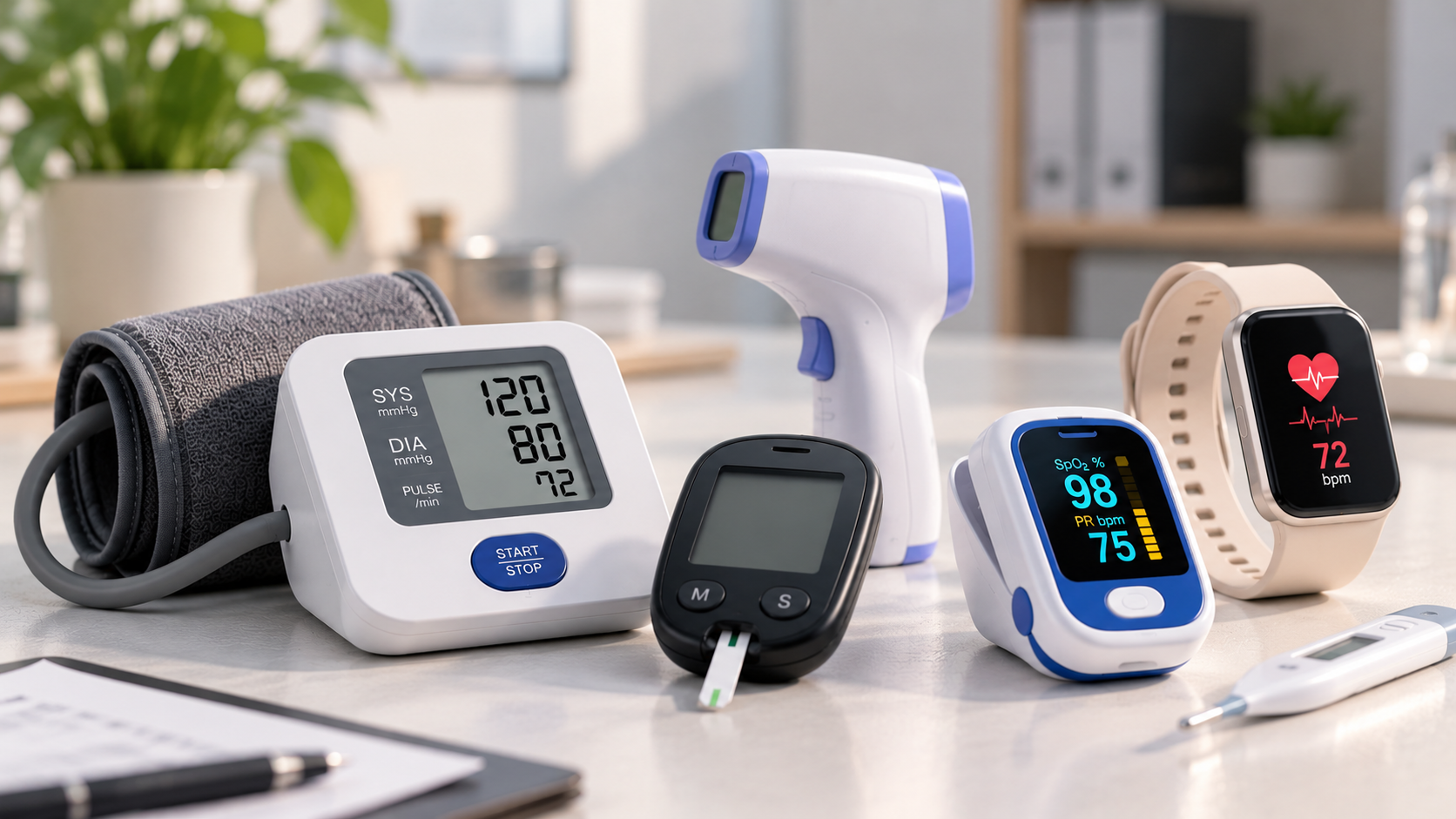
Consumer medical devices, wearables and health apps; health insurance | Not allowed |
Dietary supplements, minimally invasive cosmetic procedures | Not allowed |
Health software and infrastructure | Allowed |
Personal loans, BNPL, payments and remittances, crypto, financial planning, credit monitoring | Not allowed |
Deposit accounts, insurance (non-health), auto loans and leasing, investing and robo-advisers, credit cards, mortgages | Restricted to select approved advertisers |
Financial software | Allowed |
"Restricted" is narrower than it sounds: OpenAI says it is working with a small group of advertisers and is not taking applications in some categories.
Some categories are currently barred in every market: alcohol, tobacco and vaping, gambling, dating and adult content, recreational drugs and political ads. So are ads for individual job or property listings.
Review covers the landing page as well as the ad, so an approved ad cannot point to a page selling something disallowed. Holding a Singapore licence doesn't change this; the troubleshooting guide says a licensed business is not automatically eligible for every category or market.
What do you need before you start?
Have five things ready: your registered business details, a credit card that matches the business and its country, a logo, a landing page that loads for OpenAI's crawlers, and a way to record enquiries.
- Your registered details. The Legal Name in Ads Manager is used for billing and business verification, so use your registered name and address.
- A card and billing address in Singapore. OpenAI's billing guide says the payment method should match the account's business entity and country.
- Country, currency and time zone, chosen deliberately. The account setup guide says these can't be changed after the account is created.
- A crawlable landing page. OpenAI's ad creation guide says landing pages must not block OAI-AdsBot or OAI-SearchBot, and the ad policies say pages its systems can't review are not eligible to run. Check robots.txt and your firewall or CDN bot rules. The same access matters for organic visibility, which is part of our AI search visibility work.
- A tracking plan. Plan UTM parameters, plus a cookie consent banner if you'll install the OpenAI Pixel (see the PDPA section).
How do you set up a ChatGPT Ads account?
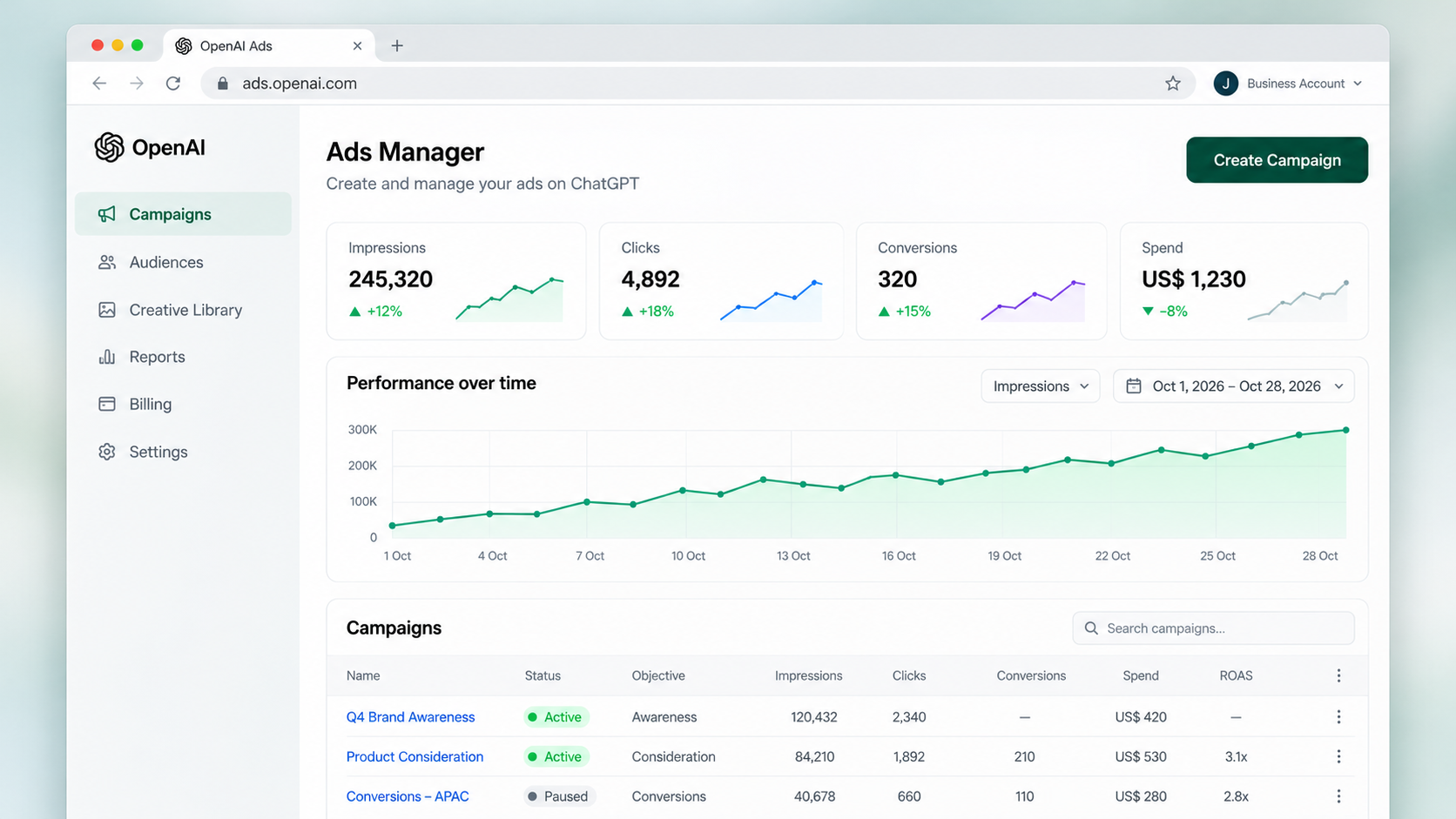
Sign in at ads.openai.com with an OpenAI login, enter your website URL or skip that step, and create the advertiser account. Then set up billing, which must be done before any campaign can deliver, and finish your logo, names and verification.
- Sign in. Use the OpenAI account you use for ChatGPT, or create one. OpenAI's quickstart suggests one tied to your work email.
- Website URL or skip. Ads Manager can draft a first ad from your site, or you can skip this.
- Advertiser name. It fills Account Name, Brand Name and Legal Name. Users see the Brand Name.
- Billing profile and card. Enter the business name, address and an invoice email, then the card. Expect a temporary authorisation hold, which OpenAI says may stay on your statement for 8 days or longer. GST-registered businesses can add a tax ID under Billing > Settings; the types offered depend on the billing country.
- Logo and names. Set both in Settings > General.
- Colleagues. In Settings > Users, invite teammates as Admin (full access), Member (create and manage campaigns) or Viewer (view only).
- Business verification. OpenAI's troubleshooting guide says the review may take up to 7 business days.
Ads drafted during signup "will go live once they pass review", so pause the campaign if you are not ready. Some accounts can spend before verification is required, so don't treat unfinished verification as a brake. And changing the Brand Name later pauses serving until it is re-approved; changing the Legal Name restarts business review.
How do you build your first campaign?
Every campaign has three layers: the campaign (objective, budget, dates, targeting), the ad group (a theme plus context hints) and the ad (title, copy, image, landing page).
The campaign. Pick one of three objectives: Views (billed per thousand impressions), Clicks (billed per click) or Conversions (oCPC or oCPM). The campaign guide says changing objective means a new campaign. You can limit delivery to Android app, Android web, desktop web, iOS app or iOS web. Custom audiences used for inclusion need at least 25,000 matched users.
The ad group. OpenAI's ad group guide recommends one theme per group, with separate groups where messaging or landing pages differ. Each group carries context hints. OpenAI's guide to context hints describes plain phrases about what you offer, who it suits and when it helps. They are not exact-match keywords or targeting rules, and don't guarantee delivery.
An illustration (not a Plexial client): "aircon servicing" tells the system little. "Same-week aircon chemical wash for HDB flats in the west" says what, for whom and where.
The ad. Each ad has six parts: advertiser name, favicon, title, copy, landing page and image. A multi-image format, using 4 to 6 square images, entered open beta on 26 October 2026. Write several distinct variations, and don't make the ad look like ChatGPT; the policies ban interface imitation.
One trap, per the quickstart: a first campaign may not offer start and end dates until published. Don't publish just to reach them; the ads could start running.
How much do ChatGPT Ads cost?
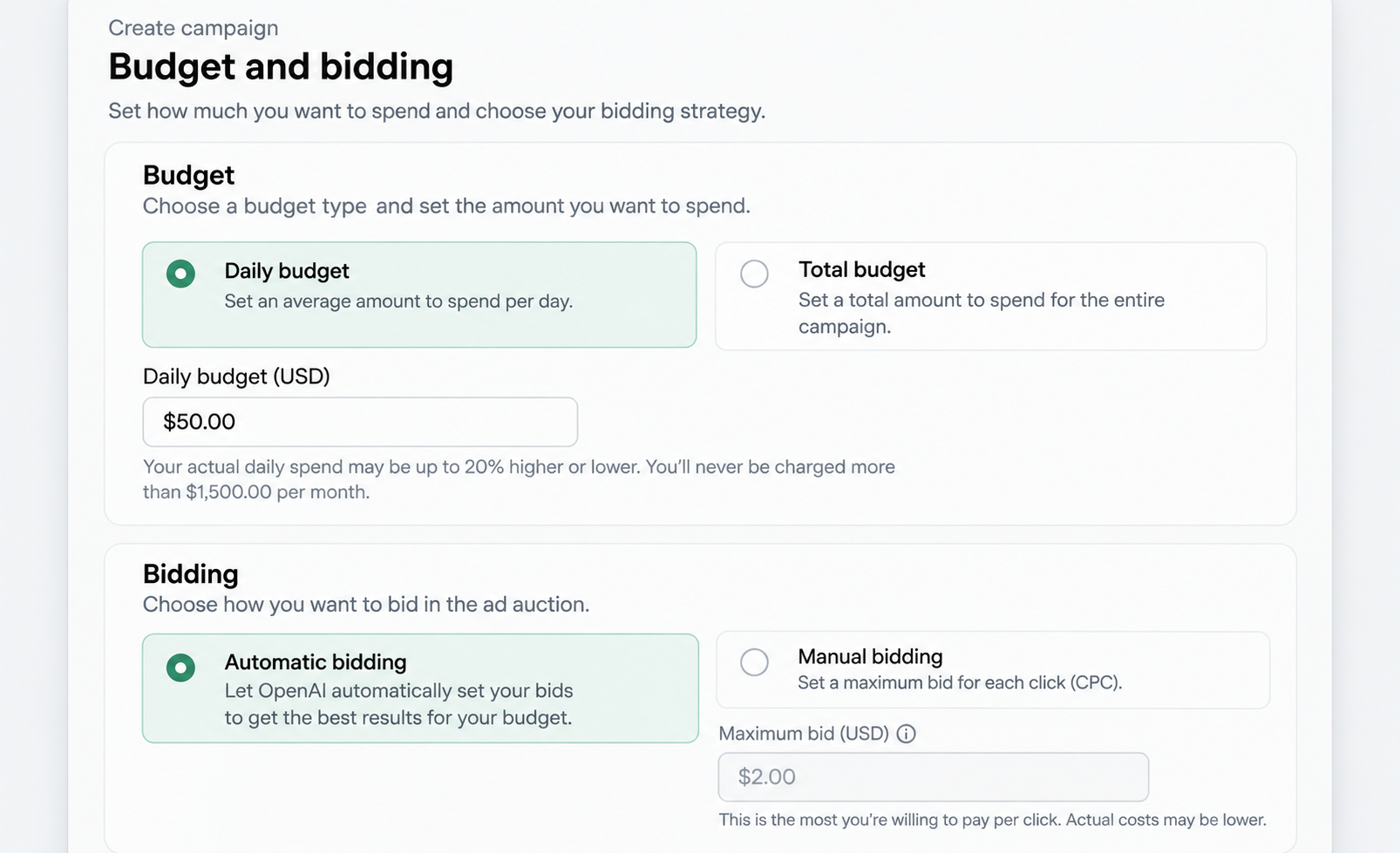
There is no rate card. You set a budget and a maximum bid, then pay per thousand impressions or per click through a relevance-weighted second-price auction, with a minimum daily budget of SGD 25.
For click campaigns, OpenAI's overview recommends starting with a maximum bid of US$3 to US$5 per click. That is a starting suggestion in US dollars, not a Singapore average. For a contrast with organic spend, see what SEO costs in Singapore.
The daily budget is an average over a seven-day week, not a cap. The budget week runs Sunday to Saturday in your account's time zone. Spend can reach twice the daily figure on one day, but never more than seven times it over the week. A campaign-total budget is the stricter control.
Billing is postpaid. Your card is charged when unpaid spend reaches the account's payment threshold, and at month end, says the billing guide. New accounts start on a low threshold that rises with successful payments. Spend figures can lag 7 to 8 hours, and ads may serve for up to 24 hours after a pause. That spend is billable.
Conversions campaigns still bill per click or per thousand impressions, never per conversion.
No reliable Singapore CPC or CTR averages have been published yet.
Simple arithmetic, not a forecast: a SGD 25 daily budget run for 30 days comes to about SGD 750.
How do you measure results and stay PDPA-compliant?
Add UTM parameters to every landing page URL for your own analytics, and install the OpenAI Pixel, optionally with the Conversions API, if you want Ads Manager to report enquiries or sales.
OpenAI's conversion measurement guide explains that each click carries a reference called oppref on the landing page URL; keep it intact through redirects. If you send a conversion through both the Pixel and the Conversions API, use the same event ID so it is counted once. Developers can follow the Measurement Pixel documentation.
OpenAI's ad-review crawlers may show up in analytics as paid visits; OpenAI says they are not billed. Ads Manager reports impressions, clicks, spend, CTR, average CPC, average CPM and conversions, with impressions, clicks and CTR refreshing about every 15 minutes.
The PDPC's Advisory Guidelines on the PDPA for Selected Topics (paragraph 7.14) say that where ad targeting collects and uses personal data through cookies, the individual's consent is required. As good practice, it suggests letting visitors set cookie preferences. The Pixel stores the click reference in a first-party cookie, and OpenAI tells advertisers to obtain necessary consents before sending conversion data. This isn't legal advice.
An ad can only report enquiries your site records. If calls or WhatsApp messages aren't tracked, read why traffic doesn't turn into enquiries.
Should you run ChatGPT Ads yourself or get help?

Self-serve is realistic for a single product with a clear landing page. Bring in help when you need several ad groups, conversion tracking across forms and WhatsApp, or a policy review before you spend.
Most Singapore SMEs are still early with AI. IMDA's Singapore Digital Economy Report 2026 found SME AI adoption rose from 14.5% in 2024 to 23.4% in 2025.
The setup is not the hard part. The time goes on eligibility checks, Pixel and consent, and writing enough distinct ads and hints. To hand that over, see our ChatGPT Ads management.
What should you do first?
Check the eligibility table first; nothing else matters if your category is closed. Then confirm OAI-AdsBot and OAI-SearchBot can reach your landing page, and get UTMs, the Pixel and consent in place. Launch one tightly themed ad group at the SGD 25 minimum and scale only once enquiries appear in your own records.
For a second opinion before you spend, see our ChatGPT Ads management or talk to Plexial.
Frequently asked questions
Are ChatGPT Ads available in Singapore?
Yes. Self-serve Ads Manager lists Singapore as available, and OpenAI began rolling ads out here on 23 September 2026.
What is the minimum budget for ChatGPT Ads in Singapore?
SGD 25 a day, set as a daily budget averaged over seven days. Campaign total budgets are also available.
Do I pay per conversion?
No. Conversion-optimised campaigns are still billed per valid click or per thousand impressions.
Can clinics, law firms or financial advisers advertise?
Not at present in Singapore. Legal services and most health services are not allowed outside the US, and most financial categories are either not allowed or limited to select approved advertisers.
Will running ads make ChatGPT recommend my business?
No. OpenAI says ads are labelled, separate and don't influence ChatGPT's answers. Organic recommendations are a separate job; see our guide to getting ChatGPT to recommend your business.
Who sees ChatGPT Ads?
Users on the Free and Go plans. OpenAI says Plus, Pro and Business subscribers, and accounts it identifies as under 18, don't see them.
Written by
Jae Tan
Jae shares insights on technology, digital innovation, and business trends, helping businesses navigate change and uncover new opportunities.